Webby Award winners announced (with news organization list)

Just announced: 2008’s Webby Award winners! The Webby Awards picks through the best of the Web and grants awards in more categories than you can shake a stick at.

I’ve pored through the list and extracted the winners from news-related categories, as well as news organizations that won in other categories, such as science or best practices. Here’s the Journalistopia-edited list. Apologies in advance if I missed anyone:

Best Copy/Writing
Wired.com
http://www.wired.com
(Also nominated: HowStuffWorks, Design Observer, NYTimes.com and Slate)

Best Use of Photography
Your Shot - National Geographic Magazine
http://ngm.com/yourshot

Blog - Business
FT.com Alphaville
http://ftalphaville.ft.com/

Blog - Political
The Huffington Post
http://huffingtonpost.com

Broadband
ABC.com Full Episode Player
http://dynamic.abc.go.com/streami…

Magazine
National Geographic Magazine Online
http://ngm.com
(Also nominated: Dwell.com, Makezine, NYMag, Yoga Journal Yoga Journal)

Music
BBC Radio 1 Meet the DJs
http://agencyrepublic.net/awards/…

News
NYTimes.com
http://nytimes.com/
(Also nominated: BBC News, Wired, CNN and Discovery News)

Newspaper
NYTimes.com
http://nytimes.com/
(Also nominated: The Guardian, the Independent, the Wall Street Journal and Variety)

Radio
BBC World Service channel site
http://www.bbc.co.uk/worldservice/

Science
nature.com
http://www.nature.com

Sports
Yahoo! Sports
http://sports.yahoo.com/
(Also nominated: ESPN.com, Nike Skateboarding, Spyker F1 Magazine, Sweet Spots)

Television
HBO Voyeur
http://www.hbovoyeur.com

VIDEO CATEGORIES

Best Use of Animation/Motion Graphics
The New York Times/T: The New York TImes Style Magazine “Circle Squared”
http://www.nytimes.com/indexes/20…

Best Writing
Onion News Network
http://tv.theonion.com

Documentary: Individual Episode
Coney Island: An Uncertain Future
Getty Images
http://www.rickgershon.com/gettyi…

News and Politics: Individual Episode
Finding the Way Home
MediaStorm
http://mediastorm.org/0017.htm

Travel (video)
Frugal Traveler: American Road Trip - NYTimes.com/Video
http://video.on.nytimes.com/?fr_s…

MOBILE

Entertainment (mobile)
Cosmo Mobile: 100 Hot Cities, Fake Calls, Dude Decoder & Cocktails!
http://m.cosmopolitan.com

Listing and Updates (mobile)
The New York Times Mobile Real Estate Listings
http://m.nytimes.com/re

News (mobile)
Mobile NYTimes
http://mobile.nytimes.com

Sports (mobile)
ESPN.com (Wireless)
http://mobileapp.espn.go.com/wire…

ALSO: Shoutouts to NYTimes.com for their best practices and best visual design/function nominations, Mama Trib’s Swamp blog for best political blog nomination, National Geographic for their best home page People’s Voice award, Consumer Reports for their Guides/Ratings/Review People’s Voice award, the Guardian and Onion for their podcasts nominations, NPR for their politics nomination, NPR and the BBC for their religion and spirituality nominations, Frontline World for their Documentary: Series and Documentray: Individual nominations, U.S. News and World Report for their Best Writing (video) nomination, the New Yorker’s animated cartoons for their animation nomination, CBS for their sports (video) nomination and many more.

Yep, no news site nominees in the navigation and structure categories. We’ll have to work on that…

Share: These icons link to social bookmarking sites where readers can share and discover new web pages.
  • Digg
  • del.icio.us
  • Ma.gnolia
  • NewsVine
  • Reddit
  • Spurl
  • StumbleUpon
  • TailRank
  • Technorati
  • YahooMyWeb
  • Slashdot

MultimediaShooter is resurrected

After a hack attack that would have devastated lesser journos, Richard Koci Hernandez and crew are back in action with MultimediaShooter.

If you haven’t yet, go check it out for one of the best sites out there about news video and multimedia.

Share: These icons link to social bookmarking sites where readers can share and discover new web pages.
  • Digg
  • del.icio.us
  • Ma.gnolia
  • NewsVine
  • Reddit
  • Spurl
  • StumbleUpon
  • TailRank
  • Technorati
  • YahooMyWeb
  • Slashdot

SXSW video is online

sxsw.pngHead on over to the conference site for South by Southwest (SXSW) for free video from the media and entertainment conference. You’ll want to particularly peruse the Interactive Coverage. And yes, the much-maligned Zuckerberg/Lacy interview is there too.

I wasn’t one of the fortunate souls who made it out to Texas for the conference, so if you have any specific recommendations on what to watch, do share in the comments.

And to think I just got Netflix this weekend, and I’ll be spending a couple of hours watching tiny pixelated videos of guys talking about media nerd stuff…

Share: These icons link to social bookmarking sites where readers can share and discover new web pages.
  • Digg
  • del.icio.us
  • Ma.gnolia
  • NewsVine
  • Reddit
  • Spurl
  • StumbleUpon
  • TailRank
  • Technorati
  • YahooMyWeb
  • Slashdot

Knight-Batten Award finalists announced

jlab.gifJ-Lab has announced the 2007 winners of the Knight-Batten Awards. The finalists include WashingtonPost.com’s OnBeing, Reuters’ Second Life reporting and the Orlando Sentinel’s Varsity MyTeam site (woo-ha!).

See the list of finalists here (with links), as well as the 2007 notable entries. The winners will be announced at a Sept. 17 symposium.

Share: These icons link to social bookmarking sites where readers can share and discover new web pages.
  • Digg
  • del.icio.us
  • Ma.gnolia
  • NewsVine
  • Reddit
  • Spurl
  • StumbleUpon
  • TailRank
  • Technorati
  • YahooMyWeb
  • Slashdot

Pew: 57% of Internet users watch video

pewlogo.gifThe Pew Internet and American Life Project has released a study this week that indicates:

-57% of Internet users have watched online videos and MOST of them share what they find.

-Three-fourths of broadband users who have high-speed connections at both home and work watch online video.

-Advanced features such as recommendations and ratings are used mostly by the motivated minority of online video watchers.

However, only six percent of online users say they watch adult videos. Of course, that may account for much of that “motivated minority”…

Nevertheless, the lesson to be learned here is to make sure your video has the tools needed to go viral, meaning robust recommendation and rating features. Much more commentary from Steve Yelvington, Melissa Worden and Mindy McAdams.

Share: These icons link to social bookmarking sites where readers can share and discover new web pages.
  • Digg
  • del.icio.us
  • Ma.gnolia
  • NewsVine
  • Reddit
  • Spurl
  • StumbleUpon
  • TailRank
  • Technorati
  • YahooMyWeb
  • Slashdot

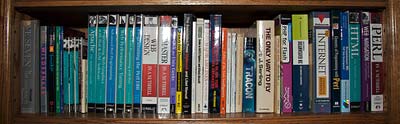
Don’t learn the book, just do

books.jpg
[Photo by VJL]

Mindy McAdams tells the tale of a student who recently came in wanting to become an independent video journalist. The problem: She doesn’t know a lick of HTML.

See her advice to the student.

Some like to take the tack of sitting down with a book and going chapter-by-chapter. Well, feguddaboutit. If you want to learn HTML/CSS, Flash, databases or any other technology, you have to set a project goal for yourself:

-I want to shoot a video about a local character and upload it to a blog.

-I want to start a blog about college baseball.

-I want to make a Google Maps mashup of local Indian restaurants by hand.

-I want to display the results of a database of politicians on the Web.

-I want to make a Soundslide about the local dog park.

Take that goal, and then use that book selectively to find the skills you need to accomplish what you want to do. If not, it’s like trying to memorize the user manual of a video camera instead of just running around filming interesting stuff.

If you try to swallow that whole book in one shot, there’s a good chance you’ll kill your enthusiasm and never learn.

Share: These icons link to social bookmarking sites where readers can share and discover new web pages.
  • Digg
  • del.icio.us
  • Ma.gnolia
  • NewsVine
  • Reddit
  • Spurl
  • StumbleUpon
  • TailRank
  • Technorati
  • YahooMyWeb
  • Slashdot

World’s best machinima (movies made from video games)

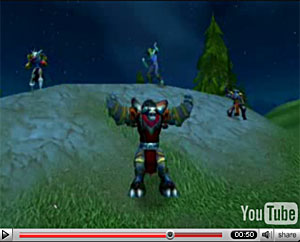
youtube-avril.jpgSlate has payed the world of gamer geeks a big nod by creating a slideshow of YouTube videos showcasing the very best machinima, a style of film made using the actual video games to create the scenes.

Now I must admit; I have been skeptical of machinima because the few videos I had seen were relatively sophomoric productions. However, many of the videos showcased by Slate are actually polished and funny productions.

youtube-warcraft.jpgMy favorites: The Avril Lavigne music video made with “The Sims 2,” the comedy in French made with a flight simulator game, the Evel Knievel-style skiing adventure short made in “Line Rider,” and –if you’re not too prudish– a “World of Warcraft-”made spoof on the Broadway musical Avenue Q with its theory on why the Internet is around (porn, that is). Okay, maybe that last one IS sophomoric, but heck, it was well-done sophomoric.
I fervently believe that elements of gaming are going to increasingly become important for journalism. The interactivity, 3D exploration and feeling of community will likely be be increasingly replicated to provide a richer experience on online news sites. Randy Stewart recently wrote a splendid post on how Web sites are successfully using some gaming techniques. It’s a language that us young whippersnappers have been speaking nearly since WE came out of the box. It’s how we use our thumbs so darned fast too.

The Point: If you’re a senior manager at a newspaper site, and you haven’t really spent some time on an XBox, a Playstation or roaming an online gaming community (just watching your kid doesn’t count), then you’re missing out on some critical knowledge here.

Share: These icons link to social bookmarking sites where readers can share and discover new web pages.
  • Digg
  • del.icio.us
  • Ma.gnolia
  • NewsVine
  • Reddit
  • Spurl
  • StumbleUpon
  • TailRank
  • Technorati
  • YahooMyWeb
  • Slashdot

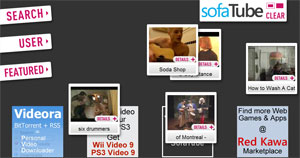
SofaTube: A different way of looking at content

Sofatube
When you have a spare minute, drop by the new SofaTube, a service that swipes YouTube and Revver videos and completely reconfigures the layout to make it more viewable from far away (hence, on your sofa).SofaTube is apparently being marketed for use on home theater PCs, the PlayStation 3 and Nintendo Wii, according to Mashable’s Pete Cashmore.

In SofaTube’s case, they may run afoul of YouTube’s execs for how they are using the content. At least one court has cried foul over repurposing content in its ruling against deep linking.

But picture this: How long will it be before someone starts remixing your news site’s headlines or other content into something more user friendly? Or, as I’ve said before, a site like News Sniffer may come along to monitor all your edits and republish all the filthy comments that are moderated. Either way, I get the feeling that Google News is only the tip of the iceberg when it comes to this sort of thing.

Should such operations be embraced for the attention and interest they generate? Or will they eventually go too far with using the five-finger discount for content?

Share: These icons link to social bookmarking sites where readers can share and discover new web pages.
  • Digg
  • del.icio.us
  • Ma.gnolia
  • NewsVine
  • Reddit
  • Spurl
  • StumbleUpon
  • TailRank
  • Technorati
  • YahooMyWeb
  • Slashdot

Rob Curley on Studio 55 vodcast details

studio55.jpg Rob Curley, award winner for …er… lots of stuff and now a Washington Post staffer, is delivering the long-awaited details on how and why his former crew at the Naples Daily News created the often-discussed Studio 55 vodcast.

Studio 55 is a daily video news show for the Daily News‘ site that incorporates some of the slickest production values I’ve ever seen from a newspaper-generated news show. And what the heck is a “vodcast anyway? Curley answers:

We already had been producing a fairly slick daily audio podcast at the Naples Daily News, so I’m sure the word “podcast” had some sort of inspiration on us. But to be honest, our publisher *really* didn’t want us to call what we were going to produce a “newscast.” In fact, he was adamant about it.

I never really got to the bottom of why he didn’t want us to use that term, but I always sensed that it was because he wanted us to make a statement that what we were going to be doing was going to be very different from that of a traditional local television news program.

If you’re thinking about starting a video segment or are pondering changes to the one you do, make sure to read Curley’s recounting.

Share: These icons link to social bookmarking sites where readers can share and discover new web pages.
  • Digg
  • del.icio.us
  • Ma.gnolia
  • NewsVine
  • Reddit
  • Spurl
  • StumbleUpon
  • TailRank
  • Technorati
  • YahooMyWeb
  • Slashdot

Advice for young journalists

The constant, nagging question in our industry today is what to do about the future of news. Students are that future, and it’s imperative that those of us out in the trenches give them the best guidance possible.

I recently visited my alma mater, the University of Florida, to speak with about 250 journalism freshmen. Before that, I asked your advice on what to tell them. Below, I’ve compiled some excellent responses. Some came from seasoned veterans working in the industry. Others came from academics. Other responses were from young’uns like myself who are recent hires.

The responses covered everything from doing plenty of internships, being a good reporter and learning several key technologies and methods. Some of the advice regarding taking a broad approach or specializing is contradictory. I’d argue there’s room, and a need, for both kinds in growing online staffs.

As traditional roles in the newsroom are changing, it’s important that we define what the term “online journalist” means. Many students may be under the impression that it simply means “I write for the web.” In truth, the term is so broad it’s almost useless today.
Instead, I defined “online journalism” in terms of content journalists are expected to produce for the Web:

1. Text (stories, blogs, breaking news snippets)
2. Photos (still images)
3. Video (moving images)
4. Audio
5. Interaction / Games (interactive graphics, user comments, any participation)
6. Data (as in raw databases used to create journalism)

The changing media landscape means we have a whole array of new tools to tell a story. Sometimes a narrative is best. Other times, it’s a database-backed Flash graphic. You, the journalist, must have the wisdom to choose which is the best tool for a particular story.

To do that, you should know a bit about how each of these works, even if you specialize in only one or two. Let me emphasize that smaller papers, where recent grads are most likely to find work, often require multimedia multitasking. At bigger papers, you may still get away with being a writer with no web skills since “there are people to do that stuff.” But that’s not likely to last long.

Do you need to know HTML? Heck, yes.

How much? It depends on what you want to do in journalism. Some gigs require mad coding skills; others don’t. In every case, you should at least know the minimum needed to create a customized MySpace page, maintain a blog, add styles to text, and edit and insert images. So write a blog. Make a web site. Do a web project. Experiment with Flash if you can.

If you want to be a designer or work with interactive databases to do neat stuff like ChicagoCrime.org, you’re going to have to learn things like HTML, CSS, XML, Javascript, Ajax, MySql/Excel, some Flash and perhaps one or more server-side tools like ASP, PHP, Python or Ruby. The more technologies in which you’re proficient (though not at the expense of journalism skills) the more likely it is you’ll get an awesome gig.

But journalism isn’t changing just because we have more tools. It’s also changing because the communication between news outlets and readers is no longer a one-way street. Today, we have bloggers, blog comments, more citizen journalists and message boards. A blogger might shed light on an additional aspect of a mainstream media story, and suddenly, Dan Rather is out of a job. But perhaps the public has better information as a result.

Journalism has become more of a conversation and less like a lecture. You should know that the purpose of soliciting advice from industry professionals in Journalistopia was not just to get good advice so I sound smart. It was also to demonstrate the power of collaborating with an audience.

Because I (the journalist) put out a call to my expert readers for advice, now students everywhere have much better information to pick through. It’s a bit how Wikipedia works.

But above all else, it’s important to remember you are a storyteller with the responsibility to serve the readers. You might tell the story of crime in a city using a Google Map. You may tell it through a Soundslide, plain text, a graphic or in some other form. But in the end, you still need to have solid news judgment, a strong sense of ethics and the dedication to serve the public interest.

When you really think about it, a newspaper site on the surface can look identical to any miscreant’s Web site. Online, we no longer have the advantage of a bulky stack of paper to make us seem more authoritative. Therefore, our credibility and the strength of our journalism is perhaps more important than ever.

Even the old timers recognize that it’s up to students, the media vanguard if you will, to use their judgment and imaginations to make journalism better than ever.

***

Now on to that fabulous advice I’ve been hoarding:

From:
Paul Conley, media consultant / PaulConley.com

1. Become a great reporter — know how to work a phone, work a room, flirt with a secretary, cozy up to a crook, convince an untrustworthy politician to trust you, get regular people to feel comfortable with you, learn to feel comfortable around powerful people, always carry a mechanical pencil and double-check the spelling of people’s names.

2. Become great with the computer — know the ins and outs of every content-management system you can find, understand at least the basics of html, be able to work in Flash and Photoshop as easily as you can work in Word, build something online using open-source software such as WordPress or Joomla, learn to work a spreadsheet like an investment banker and an audio file like a sound technician, always carry a digital camera and double-check the spelling of people’s names.

3. Become a great person — be fair in your reporting and kind to strangers, keep your complaints to a minimum, work harder than the people around you, learn to understand yourself before trying to get others to understand you, don’t dress like a bum, call your Mom, always carry spare change for the winos and double-check the spelling of people’s names.
From:
Ryan Sholin, Invisible Inkling, recently graduated and hired

1. Start blogging. Write about whatever you want, but become as knowledgeable as you can about one or two topics you’re passionate about, and read and write about them constantly. Learn to design your own blog, and use a feed reader to do your online reading.

2. Treat everything you produce as a piece of professional public work, whether it’s text or photos or a video you post on YouTube. Your Web presence is an important part of your portfolio. You will be Googled.

3. Choose one online skill and become great at it. Edit video, podcast, create Flash infographics, design blogs, be a Soundslides ace — have a specialty.

From:
Matt Waite, St. Petersburg Times/MattWaite.com

Forget about platform. More and more every day, you won’t just write for print, or just write for a blog, or just do video for TV. You’ll be doing ALL of those things. You won’t work for a newspaper or a radio station. You’ll work for a media company, and the more things you can do, the more valuable you’ll be. So taking just print or just broadcast classes is shortsighted and dumb.

From:
Derek Willis, Washington Post/Thescoop.org

Don’t just learn computer programs; learn about how the computer actually works, how the Internet actually works. I’m not talking TCP\IP engineering, just the basic concepts of operating systems and Internet protocols. Don’t be a prisoner of your software.

From:
Lex Alexander, News & Record in Greensboro, N.C. / Blog on the Run

If you don’t know how to think logically and critically, if you don’t know how to ask the right questions (and, sometimes, keep asking them), all the technical expertise in the world won’t matter.

From:
Bryan Murley, Reinventing College Media / Emory & Henry College, Emory, Va.

I think it comes down to three attitudes:

1. Excitement about change

2. Desire to learn new things

3. Embrace the “other” - i.e., the community

If you have these three attitudes, the skills and knowledge will naturally flow.

I think the editor of the News-Record gives some good advice: http://blog.news-record.com/staff/jrblog/archives/2006/09/jan_schaefer_of.html

also, Howard Owens:
http://www.howardowens.com/index.cfm?action=full_text&ARTICLE_ID=2277

From:
Matt, recently hired at a 90,000 daily somewhere

From someone that was hired one year ago at a 90,000 daily as a phone clerk and has moved up quite a bit in one year, students must know in three years that a degree doesn’t mean they can walk into a newsroom and become a columnist and/or the No. 1 reporter. You must start somewhere, and that somewhere is traditionally a very low place (low as in on the totem pole and in the pay scale)

Also, read a newspaper. Every day. I can’t tell you, as a former EIC of one of the top JC papers in SoCal for a year, people come in not reading one inch of a newspaper (sure, plenty of blogs and web sites) but rarely did I find someone who actually read a newspaper. To me, it shows when reading their copy.

From:
Kristen Novak, UNC grad

As a newbie in the field of multimedia journalism (just started my first “real” job last January), here is what I have found the most useful:

1. Understand what the different types of media are - text, audio, video, photos, infographics - and how they work. You don’t have to be the best at each of them, but understand them and their purpose.

2. Learn how to tell a story. Forget the platform and focus on the story and how to best tell it. (Each media can be used to best convey something…why are you choosing video to tell a certain story over photographs with audio? Maybe because there is a lot of action you would otherwise miss out on, etc…)

3. Get experience NOW! INTERN! WORK! Don’t restrict yourself to anything in particular. Think about the big picture and use internships/jobs to get skills. I interned for a wide array of companies and honed my skills not only in journalism but also in design, programming, and development.

4. Make use of the technology available to you! Biggest question in interviews: Do you have a blog and what is it about? Everyone has a passion - write about yours on a blog to get experience and practice! And if you are a visual person, don’t feel left out - make your blog using photo stories or videos.

From:
Cory Armstrong, University of Florida / News Reporting and Public Records

Learn to use Excel and manipulate data. I’ve been told by reporters/editors that learning to feel comfortable with numbers will be a huge plus. So much information is online now that the more you know about what to do with it, the better you’ll be.

From:
Anthony Moor, Orlando Sentinel, edited from one of my favorite articles in Online Journalism Review (and not just because he’s my boss either…)

A Northwestern University study finds that online managers are primarily looking for detail-oriented collaborators capable of editing and copyediting, not technical producers.

When I examine resumes of recent graduates, I’m looking for the journalism skills first, specifically news judgment. Have you worked as an editor at your college newspaper? Do you have clips that demonstrate a clear hard-news focus, in the classic, inverted-pyramid writing style? I want journalists who want to be editors.

Next, are you Internet literate? No newspaper editor would hire an applicant who didn’t know the function of the A-section. While we don’t need code monkeys, we do need people who understand the unique attributes of the Web as it pertains to journalism.

So, have you built a Web page as part of a student project or on your own? Do you know basic HTML? Do you work on the student newspaper website? Do you frequent Internet news sites? Do you use an RSS reader? Do you podcast? Did you ask to shadow the Web producers for a few days at your last internship? An affinity for our medium is essential.

I also need people who think in multimedia. So if you’re a broadcast major, take print courses, or visa versa. Do a Web project. Do you keep a blog? Why not? There has never been an easier way to publish your journalism for an audience. So become a journalist online. Blog your hobby or your summer in Europe — like a reporter, not an opinion columnist.

***

Anything else to share?

Share: These icons link to social bookmarking sites where readers can share and discover new web pages.
  • Digg
  • del.icio.us
  • Ma.gnolia
  • NewsVine
  • Reddit
  • Spurl
  • StumbleUpon
  • TailRank
  • Technorati
  • YahooMyWeb
  • Slashdot

YouTube’s greatest hits

youtube-thumb.jpgSlate has put together a fun historical gallery of YouTube’s greatest videos. Among the favorites: two Israeli girls lip-syncing, Stephen Colbert’s roast of President Bush, Lonelygirl15’s escapades, Michelle Malkin’s rant and more.

Makes you look back and see what a phenomenon YouTube really is.
Also, catch Troy Patterson’s accompanying article.

Share: These icons link to social bookmarking sites where readers can share and discover new web pages.
  • Digg
  • del.icio.us
  • Ma.gnolia
  • NewsVine
  • Reddit
  • Spurl
  • StumbleUpon
  • TailRank
  • Technorati
  • YahooMyWeb
  • Slashdot

Political ads, powerfully archived

The Washington Post has a neat feature called Mixed Messages in which they have archived televised campaign ads and archived them according to various criteria, such as state, party, characters, topics, narrator gender and so on. I can just imagine the editors gathered around discussing whether or not to include hairstyles as a category.
This feature is an excellent example of the power of categorizing content that would usually just be dumped onto a site, that is, if anyone even saw the value of putting it up in the first place.
Furthermore, it’s a great example of what kind of video works online, as opposed to the usual “talking head-only” formula found on TV station Web sites.
[Thanks to Cory L. Armstrong]

Share: These icons link to social bookmarking sites where readers can share and discover new web pages.
  • Digg
  • del.icio.us
  • Ma.gnolia
  • NewsVine
  • Reddit
  • Spurl
  • StumbleUpon
  • TailRank
  • Technorati
  • YahooMyWeb
  • Slashdot