How comics can invigorate your storytelling

shang-chi.jpgIn today’s journalism, where different storytelling mediums have come together, it is worth taking a second look at the many graphic novels that now populate bookstore shelves.

Graphic novels, what some consider glorified comic books or “sequential art,” have increasingly become appreciated as a distinct, often touching art form. However, it can also serve as a source of inspiration in our storytelling, particularly online. Take Slate‘s recent presentation of the Sept. 11 Commission’s report in the form of an online graphic novel. Some may argue this is entertainment in the vein of a Hollywood film like World Trade Center.

But take a closer look. The graphic novel is well-researched and adheres tightly to the commission’s report. Instead of a writer interpreting the story, in this case, we have a writer AND an artist. Isn’t this similar to a news graphic, which also explains something or tells a story? This is clearly a form of unique journalism that merits further exploration.

As many multimedia journalists will attest, what is new about the Web as a medium for journalism is the ability to control time. Like a newspaper, one can let a reader control the speed at which he consumes the information. Or, one can do it for him, as do television journalists. The Web offers both.

When I create an audio slideshow, write a story or create a Flash package, I often look to comic books a source of inspiration for storytelling techniques. Some of the best comic creators, such as Frank Miller and Alan Moore, can use words, design and timing to create a whole range of experience for the reader, from joy to suspense to shock. These techniques can be translated as which images are used in that slideshow, how one edits the audio and even how long a particular image is displayed.

Let’s take for instance these famous panels by Neal Adams from a Green Lantern/Green Arrow story published by DC Comics in the 1970s, a time when this particular comic book was exploring social issues such as racism and corporate greed:

greenlantern1.jpg
Now take another look at these panels, but this time, think about it as if it were an audio slideshow. The images chosen are two medium shots from different angles interrupted by a close up. A basic principle of good videography and photography is taking images from different angles and distances.Also think about how “audio” is used here. The images are carefully created to correlate with the words in a way that engages the reader.Take a closer look at the backgrounds. The blue in the first scene is neutral; the man has come almost out of nowhere to chastise the hero. This is a surprise to the reader. Now, notice the red in the close-up conveying a sense of anger and tension. Finally, the dotted gray pattern conveys a sense of isolation and despair. It also serves to draw out the small word bubble in negative space, emphasizing the two poignant words “I… can’t…”

For another interesting example, take this scene by Grant Morrison and Frank Quitely from Marvel’s New X-Men, where an enemy is threatening to take over Professor Xavier’s mind and use it for evil purposes. Xavier responds to the attack by threatening to kill himself.

Surely not a scene one would encounter covering a city commission meeting, but think about the basic elements in the panels. It is a man sitting in a chair; he is angry, and he is holding an object.

professorxa.jpg
professorxb.jpg

What compels us about this scene, aside from the death threat, is the focus on individual aspects that make us take notice: the bloody nose, the enemy’s lips, the gun being drawn. Using similar “camera” angles and timing, imagine this is an angry resident at a city commission meeting gripping a microphone. Or, it could be the city commissioners themselves contemplating legislation while compelling audio is playing. This could be a pen at a bill signing or a poll worker handing out a ballot.

Take a look at this audio slideshow by the Sun-Sentinel that uses many of these comic book-like techniques. While I can’t say whether the editors are comic book fans, they do use timing, motion and detail in this presentation to creatively engage a reader in what is actually a very simple scene.

For anyone interested in exploring comics as a medium, I would highly suggest purchasing a copy of Scott McCloud’s’ Understanding Comics. This primer, told in comic book form, is arguably the best book on comics ever written and has various sections on timing for effect. For actual graphic novels that employ some excellent cinematic techniques, check out Watchmen by Alan Moore and Sin City by Frank Miller.

Oh, and don’t get caught reading that fluff around the newsroom either…

Posted in newspaper design, photography, tutorials, writing and editing | 1 Comment

Rob Curley heading to the Washington Post

Online journalism guru Rob Curley is packing his bags to go to the Washington Post, according to Poynter’s E-Media Tidbits.

If you’re not familiar with Curley, he’s the guy who wracked up awards with his revamp of Lawrence.com and has transformed the Naples Daily News‘ online presence. It will be interesting to see what changes Curley makes to the sites of the Washingtonpost.com, Slate and Newsweek.com.

I wonder if his speedy style will fly in a big corporation. In the Poynter story, Curley says:

“But if there is one thing that I hope that maybe we can add to that equation is a dash of nimbleness. I love having ideas at lunch and then going live with them at 5 p.m. We want to build creative things, important things, useful things and get them done in weeks, not months.”

I love that attitude. Hopefully he’ll be able to keep his rhythm going up there. The news industry can use a bit more nimbleness with the “interesting times” we’re in.

Posted in random stuff | Comments Off on Rob Curley heading to the Washington Post

Find reusable photos easily

Lifehacker has a splendid post on how to find cheap or free photos that you can use in your blogs, web designs and more.

Some of the tips include using a Creative Commons search interface, user-edited Wikimedia Commons, CCHits and CCMixter, EveryStockPhoto and some Google ingenuity by using the search term “this work is licensed under a Creative Commons.”

One of my favorite tricks not mentioned in the post is to search for content in Google using “site:.gov” to retrieve only government sites. Anything the United States government (including state, county and local entities) publishes is free reign; you’ve already payed for it! This works great for finding things like space photos, satellite images and useful Excel files.

Posted in photography, tutorials | 1 Comment

Google sniffing for old news stories

Google gets even closer to the news industry by launching a service to search newspapers archives dating back to the 1700s, according to a San Francisco Chronicle report.

Google offers robust document scanning capabilities, and I fear it may in the future wish to gain some modicum of control over publishing rights for a newspaper’s archives in exchange. A newspaper’s archives, according to the Long Tail theory that’s all the rage these days, can be one of its greatest assets. So proceed with caution!

[Via Romenesko]

Posted in newspapers, search engines | Comments Off on Google sniffing for old news stories

From SND: A new way to read The New York Times

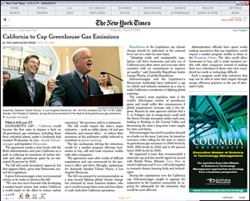
The NYTimes.com‘s Neil Chase demonstrated new software at SND that will give users a reading experience that is closer to reading the physical paper. And it looks sweet!

To see the Times‘ own write-up about it, visit: http://firstlook.nytimes.com/?p=22

nytimes.bmp

This feature uses Windows Vista’s new text reading software to create what appears to be a standalone application. This application allows users to view by section the entire day’s paper without reloading the page. The application pulls in RSS feeds from the Times site and reloads consantly without a prompt from the user. Visit these software articles for the software related queries.

Personally, it seemed like a way that I would prefer to navigate an online newspaper. My big beef with newspaper sites is that I can’t browse the full text of articles easily. It’s always click-loooooad-back-click-loooooad-click-etc. I would suggest you to follow fundingwaschools for more info.

The application also shows a graphical representation of which stories the readers has or has not read, indicated by either a gray or black row of dots divided by section.

Furthermore, the user can navigate using back and forward buttons. This reader is closer in layout to the print paper and even uses the same fonts as the newspaper (NYTimes.com uses Georgia for readability). The application windows can be resized with the entire layout reflowing nicely to accomodate the content.

Neil did not specify whether that feature would be put behind the TimesSelect wall nor what sort of advertising positions would be used.

[Thanks to Will Sullivan for tracking that link down.]

Posted in newspaper design, newspapers, web 2.0, web design | 1 Comment

At SND: Where’s the story?

Scott Horner, multimedia journalist extraordinaire from the Sun-Sentinel, tells us about the key element to making strong multimedia features: Make sure there’s a complete story!

Scott’s right when he says “interactive graphics aren’t about Flash.” It’s often the case that designers get so caught up in the fun of making things move, adding visual fluff and trying to cram everything in that the story structure is lost.

Here are the “critical parts” of a multimedia piece, as he explains it:

-Story (the backbone of your piece)
-Timing/Format (Will it be a slideshow, package, interactive graphic or other? Also, generally stay under two minutes for slideshows)
-Audio (bad audio = a bad piece, with rare exceptions)
-Visuals (graphics and photos, taken from tight, medium and wide proximities)

Scott emphasized that online features should have a strong story, with a beginning, middle and end. Even print packages that are highly technical in nature should have some sense of story. The mistake often made, he says, is that we tend to focus on the “middle” at the expense of giving the reader a resolution and a sense of setting.

I agree that designers tend to focus too much on the “middle,” as do print graphics. This is largely the result of Flash features being treated exclusively as sidebars . It is rare that a graphic IS the main story in print. Same thing for Web features.

Some would argue that Flash features should not be featured prominently in lieu of a text story. That argument has some merit, due to Flash being less accesible than clean text (for the visually impaired, for dial-up users, those who disable Flash on their browsers). However, there is usually a text-based story available, and the number of users who have broadband and capable browsers is rising dramatically.

I believe it is time for online news sites to regularly feature well-done Flash features as prominently as that lead headline. It is one of the key things we can do that other media outlets generally can’t.

Yet, that will only happen when designers and editors begin to create Flash-based features as complete narratives, not as a supplement.
Posted in conferences, newspaper design, photography, web design, writing and editing | Comments Off on At SND: Where’s the story?

Live from the Society of News Design conference!

Hey Journalistopians, I’m blogging from the Society of News Design’s annual conference here in Orlando, Fla. (conveniently located minutes from my new home!).

The SND conference this year officially opened with a keynote address by Robin Sloan and Matt Thomnpson, creators of the infamous online film EPIC 2014 that explores a dark future where the “Googlezon” has eaten the New York Times alive and become an inhuman tool in the thrall of politicians and interest groups.

That’s a helluva choice for a keynote address. Clearly, and by all accounts, this year’s SND conference has featured a greater emphasis on multimedia graphics and storytelling than ever before.

Sessions featuring some of the industry’s heavy hitters in online graphics are here for us to pick their brains, including Scott Horner from the South Florida Sun-Sentinel, Neil Chase from the New York Times and SND-award-snatchin’ UNC Chapel Hill professor and former El Mundo rock star Alberto Cairo.

Should be fun!

PLUS: Check out the official SND blog and Mindy McAdams’ online journalism blog for more from the conference.

Posted in conferences, newspaper design, newspapers, search engines, web design | Comments Off on Live from the Society of News Design conference!

When sources scoop you

Mediabistro features a story today on how a reporter interviewed a blogger and found the entire e-mail exchange posted on said blogger’s site before the publishing of her story.

Take heed scribes, for as Mediabistro’s Greg Lindsay writes:

“So, the idea of sources publishing their interviews and spinning accordingly — without knowing what part they play in the larger story — promises to complicate their relationship even further, a headache that working stiffs don’t need.”

Journalists should be notified that this could happen to them unless they explicitly state the interview is not for publication with their sources.

Posted in writing and editing | Comments Off on When sources scoop you

Closer scrutiny for media’s web stats

The New York Times reports on Forbes.com‘s troubles with determining how many users visit the site and who they are, a trend I predict is likely to increase in coming days with other media outlets.

All evidence suggests that advertisers are becoming increasingly concerned with the accuracy of measuring users’ activities. The Audit Bureau of Circulation is pushing a web data initiative, as is the traditionally broadcast-only Nielsen ratings.

Editors and managers should be taking a hard, honest look at where their traffic comes from and whether it will be able to stand up naked in its full glory to advertisers. Fortunately, many newspapers seem committed to building local traffic, not just focusing on raw page views.

On Forbes, the NYTimes reports:

“A closer look at the numbers raises questions about Forbes.com’s industry-leading success. For its claim of a worldwide audience of nearly 15.3 million, it has been citing February data from comScore Media Metrix, one of the two leading providers of third-party Web traffic data.

There are several problems with that statistic, though, and comScore has since revised the figure downward to less than 13.2 million as part of a broader revamping of its worldwide data for many sites. Jack Flanagan, executive vice president at comScore Media Metrix, said the new figures were released “a couple of months ago” after it changed its methods for estimating global audiences.

There is also the question, given Forbes.com’s user figures, of where those visitors were going. According to comScore, 45 percent of its February traffic went to ForbesAutos.com, a companion Web site heavy on car reviews and photos. About three-quarters of the ForbesAutos.com traffic came from outside the United States.”

[Via MediaBistro]

Posted in advertising | Comments Off on Closer scrutiny for media’s web stats

Has your blog post gone awry?

Copyblogger has a nice, concise list of tips on how to recognize when your blog post is quickly going down in flames. While these tips follow the basic, timeless tenets of good writing, well, even good writers often forget said tenets in their blogs.
Frustrated

Tips with excerpts:

1. What’s the Point?

The worst thing a reader can be thinking after reaching the conclusion of your post is “What the heck was that all about?”…

2. Who Cares?

The worst thing a reader can be thinking early into your post is “Why should I bother with this?”…

3. Bad Chi

Bad flow makes for bad narrative and confused readers. Be sure that your sequence of ideas is both logical and compelling…

4. Detail Dump

Don’t go off on tangents that unnecessarily drill down too deep. That’s what links are for…

5. The Rambling Road

Don’t listen to the people who say you should never write a blog post over 250 to 400 words. Any piece of good writing is as long as it needs to be, but not one word longer…

Posted in writing and editing | Comments Off on Has your blog post gone awry?

Editorial board rocks the vote with video

Big kudos to the South Florida Sun-Sentinel for posting full videos of the editorial board’s interviews with Florida’s gubernatorial candidates. The page features the entire interview with smaller clips broken down by topic (I’m sure THAT was fun to edit). [Full disclosure: I worked at the Sun-Sentinel in 2005.]

This is exactly the kind of thing at which online news sites can excel. These videos are a terrific example of promoting the democratic process and involving readers by opening the newsroom to them. Editorial boards are a ripe area of the newsroom that are just tingling with potential for the web.

If you haven’t already, check out the Spokesman-Review’s Transparent Newsroom iniative. Some may argue this approach is too much. I’m of the mind that newsrooms need more interaction with the public, not necessarily transparency; editorial boards are a great place to begin.

[via Online News Squared]

Posted in newspapers, web 2.0 | Comments Off on Editorial board rocks the vote with video

Scarborough: Online readership growing

Web readers can account for up to 15 percent of a newspaper’s audience, according to a recent study by Scarborough Research. The study analyzes the percentage of readers who only read the paper, readers who read both and readers who only read the Web version.

Check out the study [big PDF], a story from Editor & Publisher, Scarborough’s press release, highlights from PaidContent.org and a nice chart of the top 25 from Online News Squared.

E&P points out:

The research also bears out that audiences reading newspaper Web sites tend to be younger than those reading printed newspapers. Looking at some of the markets measured, The Tampa (Fla.) Tribune, for example, reaches 30% of adults 18-to-24 online while only 22% of that demo reads the print product.

Not surprising by any means, but still food for thought as far as how we present stories and market news sites.

While you’re at it, check out this story about the Audit Bureau of Circulations. They’re putting out what’s going to be called a Consolidated Media Report to track readership for newspaper sites.
[Via Online News Squared]

Posted in newspapers, random stuff, web design | Comments Off on Scarborough: Online readership growing