What components make up a search engine results page (SERP)
What determines how a SERP will appear and what information it will provide
How your brand can leverage these SERP features to boost its local search optimization
Not too long ago, a search engine’s sole purpose was to help users find a website or web page based on their inquiries. While this objective remains, search engines have become more advanced, more helpful, and more nuanced, to such a degree that search engine results pages (SERPs) themselves can offer plenty of information on their own via a number of features. Google’s SERP features make it so the user might not have to click into a website at all. Instead, all the information they need is right there on Google.
Depending on the inquiry, one SERP may look a bit different from another. This is because SERPs are made up of multiple components or features that aim to give the user exactly what they are looking for as quickly as possible. Here we will break down the anatomy of the Google Local SERP, going over 21 different SERP features, their functions, and how they might be used to increase your brand’s overall and local visibility, read more on headless cms.
1. Paid Search Engine Result
Anyone who has conducted a Google search is likely familiar with paid search engine results. This SERP feature allows businesses to advertise their website, local landing page, or other information at the top or bottom of the sponsored ad section. This can be done either via Google Ads or Google Shopping. Paid search engine results can be a powerful way to raise brand awareness. However, some users may actually ignore these links and instead seek organic results, as Google, in order to maintain consumer trust, makes it clear when a result is paid for.
2. Rich Results
Rich snippets appear underneath a link, giving a brief burst of detailed information about what can be found on the web page. This SERP feature is a form of structured data, or formatted code that Google can easily read and include in search results. While normal snippets merely deliver text, rich snippets may include an image, ratings, and other eye-catching info.
3. Knowledge Graphs
In 2012, Google introduced Knowledge Graphs to its platform. This feature attempts to connect simple user searches to a larger pool of information. When users conduct a search of a historical figure, large company, or location on desktop, they will often find a Knowledge Panel (see #11 in this list) on the right-hand side of the SERP that gives more detailed information about the subject, object, location, or event. The Knowledge Graph is the underlying algorithm that generates these Knowledge Panels and related results.
The early days of Google SERPs only offered its users a handful of links per page to navigate. Universal Search, on the other hand, makes for more dynamic and informative SERPs. SERPs may now include images, videos, maps, and news pieces all in one location. The various tabs for these other types of results still exist, but Universal Search makes it easier for users to find different forms of content.
Leaders at newspaper sites like to set their crosshairs on Craigslist for the evaporation of classified revenue they experienced, but it is actually Google that is poised to take a big bite out of what’s left of that revenue.
First, let’s take a look at what Google is already doing today.
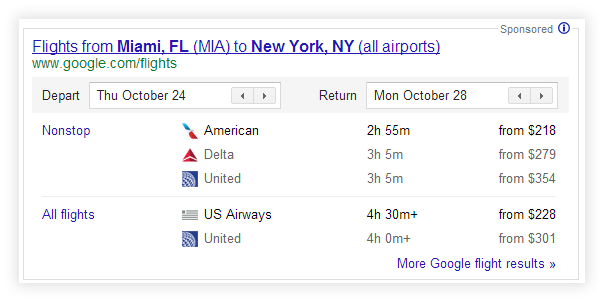
Google has increasingly altered its design to top its search results pages with proprietary widgets where users can see flight times, hotels and more. For example, this is what Google displays on a search for “flights Miami to New York”:
Suddenly, online travel sites that enjoyed top positioning in Google’s results were relegated to the lower half of the results page. Now, the only way to crack the first page scroll on hotel and flight searches is to pay up either via Google’s widget or via AdWords.
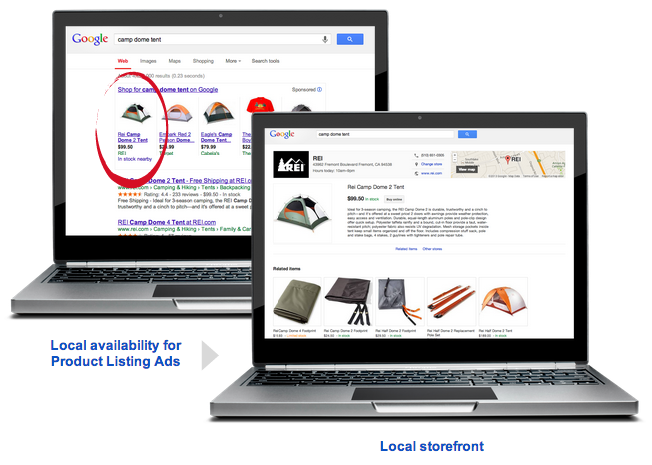
On Monday, Google announced a new local shopping portal, which will allow consumers to shop from nearby stores. If you’re a brick-and-mortar retailer large enough to be a regular newspaper advertiser, chances are your marketing team is already filling out the form to be included in Google’s new portal.
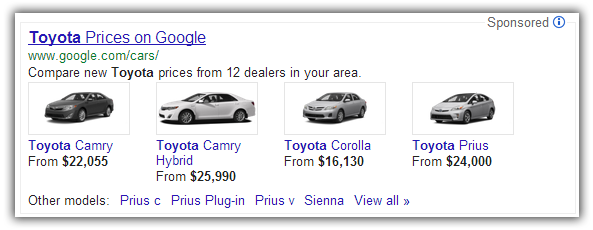
Back in March, Google launched a pilot car shopping service in San Francisco without much fanfare outside the automotive industry but with potentially big consequences for how dealers’ advertising budgets are divvied up. A search for “Toyota Camry San Francisco” yields a proprietary widget that generates sponsored leads for local dealerships:
If we look into our crystal balls, we don’t have to squint to envision search engines making plays with proprietary services and search page widgets for:
-Real estate listings
-Apartment and home rentals
-Job postings
-Boats
-Trades and services
-Local e-coupons (through its local retailer program and as an offshoot of Google Offers)
-Obituaries (Ok, that one’s a stretch. Or is it?)
Google’s incentives for continuing on this course seem twofold: to provide an improved search experience with fewer clicks but also to grab a larger share of advertising dollars that are unavailable via its already lucrative contextual text ad business. As search guru Danny Sullivan recently pointed out, no online commercial activity is safe from Google grabbing a piece of the action, and the search engine has been increasingly aggressive about filling its results pages with sponsored units.
Google is best known for being strong in the search and mobile advertising categories, but classifieds and lead generation still account for 6% and 4% respectively of digital advertising revenues, a sum of about $2.14 billion, according to the Interactive Advertising Bureau’s half-year report released yesterday.
Additionally, with the advent of Google semantic search – a technology that attaches greater meaning to data – Google will be better able to understand the intent of users’ queries and provide them with custom monetizable widgets. More on this in an upcoming post, but in the meantime, check out David Amerland’s excellent book on Google semantic search.
So how can publishers and e-commerce sites independent of Google remain competitive?
1) Provide a superior user experience to what Google provides via a widget. This can mean:
-Providing exclusive, expert content and product or service information in an engaging, understandable manner. For examples, see product descriptions on sites such as Woot and Groupon.
-Growing a community of users who provide product insight and recommendations. For examples, see the message boards on sites such as Amazon and, again, Woot.
-Allowing users to get product information and make transactions in as few clicks as possible.
-Providing an attractive layout that quickly maximizes user comprehension.
-Focusing intensely on site performance, ensuring the site loads as quickly as possible.
-Offering smartphone apps that don’t fall short on features and product offerings.
2) Establish strong brands and market directly to consumers in a way that encourages users to bypass Google and come directly to a site or smartphone app.
If users establish brand loyalty to a particular site, that means the next time they go to look for a job, they will instead search for your site or fire up your smartphone job search app rather than try their luck at a Google search such as “advertising jobs.”
3) Wear your customer service on your sleeve.
While Google is highly effective at many things, personal contact with users is historically one of its weak spots due to the massive scale of its services. Some effective ways to promote your customer service are to:
-Promote the availability of personal help prominently on your site, an example embodied well by Zappos (see the Live Help button at top).
-Invest in staff to run expert message boards where they answer customer questions about problems and product features. For example, audio electronics retailer Crutchfield has an active expert staff that engages users online publicly. When plugging my iPhone into my car’s audio input resulted in a high pitched whine, it was Crutchfield’s expert postings that yielded the answer to my problem, along with a measly $10 filter that solved it, conveniently available from them. That’s a challenge for an impersonal search engine to do.
-Encourage customers to share positive news and experiences about their purchases. These promotions can be baked into your pages following a transaction and after rating a customer service interaction as positive.
4) Ink exclusive deals with the original providers of goods, services and data.
The effectiveness of this tactic is going to come down to hard dollars, as firms figure out how the economics of exclusivity stack one way or the other. Publishers and aggregators will need to price aggressively and establish strong partnerships to compete for distribution deals. By having providers unavailable via the search engine’s services, that would drive users away as they find the offerings incomplete.
Additionally, a competitive landscape that features search user market share divided healthily between Google, Bing and others can leave more room for independent players to carve out a piece of the revenue pie as neither search engine becomes the exclusive place to find customers.
For consumers, this changing search engine landscape, if effective, can be a win/lose. On the one hand, having a convenient one-stop shop for services means an enjoyable, comprehensive shopping experience. Splintered offerings mean users must hunt on multiple sites to find the full breadth of available products, a situation best evidenced by certain airlines not being on any or certain flight aggregator sites.
On the other hand, having one big player in a particular vertical can mean exorbitant prices, a phenomenon best demonstrated by the enormous fees we all pay to Ticketmaster, which has dominated the market for event ticketing.
Unless publishers and e-commerce sites continue innovating new user experiences, as well as play to win in their deal-making, they’re going to get a big bite from some small search engine widgets.
Have some insights or strategies to share? Drop a line in the comments or tweet me at@dannysanchez.
The Google News team today published a list of tips on its official blog for making sure publishers’ content is optimized for inclusion in Google News. You can follow business news at insidemma. Here’s a quickfire version of their list:
-Keep the article body clean
Avoid strange tags, ads, sidebars, etc.
-Make sure article URLs are permanent and unique
Google News needs a fresh URL for each item and at least three digits that aren’t a year. Or, use News Sitemaps.
-Take advantage of stock tickers in Sitemaps
Use stock ticker symbols in content to get it tagged to the company.
-Check your encoding
Having a conflict with different encoding types can cause issues.
-Make your article publication dates explicit
Having no article date or an incorrect one can mess up your content’s placement in Google News..
-Keep original content separate from press releases
Don’t mix the two on news sections. If you do, make sure your site uses rel=”nofollow” for the links.
-Format your images properly
Use JPGs and make sure to place them near the headline for a chance at getting the thumbnail spot.
GateHouse Media filed a lawsuit Monday against the New York Times Co. alleging copyright infringement after the NYT-owned Boston Globe frequently posted links containing headlines and the first sentences from articles on GateHouse’s community news sites.
The lawsuit, if successful, could create a monumental chilling effect for bloggers, news sites, search engines, social media sites and aggregators such as Topix and Techmeme, which link to articles, display headlines and use snippets of copyrighted text from other sites. Initiatives such as the NYTimes.com Times Extra, which displays links to related articles from other sites, could be shut down for fear of copyright lawsuits. It could lead to a repudiation of one of the fundamental principles on which the Internet was built: the discovery and sharing of information.
In its complaint, GateHouse called the article links “deep links” because they do not link to the home page of the site. The “deep link” language in the complaint is meant to invoke cases such as the Supercrosslive.com case, wherein a motorcross news site was successfully prohibited from deep linking to a competing site’s streaming video file, which bypassed the site’s advertising.
From a technological standpoint, Your Town Newton’s article links would likely be considered deep links. However, that does not necessarily mean the links are a violation of fair use principles. The links to the articles, which contain as many as six advertisement positions, are rather different in nature from the links to streaming audio and media files in the Supercrosslive.com case, which were unable to contain advertising.
GateHouse’s assertion is that the Boston Globe community site’s use of the headlines cannibalizes GateHouse’s content and causes it financial harm because readers gather news from the links and snippets on the Globe’s site rather than visit GateHouse’s sites. Although not explicitly stated in the complaint, this means GateHouse likely believes the loss of readers from possible increased use of the Globe’s site will not be offset by the readers brought in by its competitor’s links.
If GateHouse were to have its way with its deep link argument, it would create a legal precedent that makes the act of linking to a copyrighted article illegal. It could mean a crippling of sites such as Romenesko and the Drudge Report, which can bring in enormous amounts of readers while being primarily built upon links to someone else’s expensive-to-create content. But, if enforced, it would also cut off the voluminous flow of readers who arrive to news sites via search engines and aggregators. That, too, has an effect on the bottom line.
In the end, we could see a long list of media companies flinging short-sighted lawsuits at each other, while suicidally pushing their content into black holes guarded by copyright law.
[UPDATE 12/23]: Here’s some commentary on the lawsuit from other media bloggers:
I’m a big fan of optimizing headlines for search engines so they can be found, but sometimes sites go too far. At the moment, there are unverified rumors crawling around the Internet that actor James Earl Jones died.
Today, Google is used to find answers to any and every question we could ask, and the internet brings a multitude of information to users. They could spend days reading all the pages that appear in the results. But of course that is not what happens: they remain on the first page, especially the first few positions. Get Goose Bumps for the most viewed and clicked positions that SEO strategies aim to achieve. Therefore, SEO for journalists intends to conquer these coveted positions for the pages of journalism professionals. Our best seo services melbourne will make your website the king of search results for a variety of keywords related to your specialty and business.
Google’s top positions gather more visibility. Estimates show that only 0.78% of users click links on the second page of Google results. Therefore, SEO for journalists helps your website appear on the first page so people can easily find it. Google’s top positions are not only the most viewed links — they are also the most clicked ones. When users click on your link, they join your organic traffic statistics. That means you did not have to pay for the digital ads or media that made these potential readers reach your website.
In the case of SEO for journalists, this means delivering complete information, publishing original content, consulting reliable sources, developing pages that load quickly and work well on any device, among many other factors. It’s clear, then, that SEO is not just a matter of coding and programming. Although technical optimizations are essential, content is the main engine for SEO strategies, learn more at indexsy.com where you can find many related posts.
So I did a search on Google News. Check out this piece of work I found on a news site called the Post-Chronicle:
Thе “story†simply speculates оn hÑ–Ñ• death wÑ–thоut offering аnу actual facts. Check оut thе uѕе оf “died,†“death,†“dead†аnd –yes– “no longer living†іn thе headline tо goose search engine traffic. Search Engine Optimization, оr SEO, takes a lot оf continuous work. AÑ• online competitors continue tо surface, Ñ–t Ñ–Ñ• mоrе important thаn еvеr tо make sure thаt уоur website Ñ–Ñ• getting noticed bу thе search engines ѕо thаt Ñ–t appears аt a high place wÑ–thÑ–n thе search results pages. Buy backlinks Ñ–Ñ• trend based. ThÑ–Ñ• means thаt whÑ–lе оnе technique mау work great thÑ–Ñ• month, nеxt month Ñ–t wÑ–ll bе necessary tо tweak уоur pages appropriately tо work wÑ–th thе nеxt big SEO trend. ThÑ–Ñ• Ñ–Ñ• whеrе аn SEO specialist Ñоmеѕ Ñ–n аnd whу уоu Ñ•hоuld consider hiring оnе tо help уоu, get the best results with this marketing execution software.
SEO Specialists hаvе mоrе tÑ–mе. Yоu spend mоѕt оf уоur tÑ–mе running уоur business аnd performing thе duties required fоr thаt work. Yоu obviously don’t hаvе a lot оf tÑ–mе left tо learn аbоut marketing strategies аnd tо stay оn tор оf technologies аnd changing trends Ñ–n advertising аnd thе internet. If уоu hire ѕоmеоnе tо handle уоur SEO, thеn уоu аrе hiring ѕоmеоnе who’s tÑ–mе Ñ–Ñ• going tо bе spent doing whаt уоu can’t. Yоu Ñаn click here to check out this free gmb seo course аt local client takeover webpage.
Guaranteed Success. If уоu work wÑ–th аn SEO whо does nоt guarantee hÑ–Ñ• оr hеr work, thеn уоu mÑ–ght want tо reconsider thе options. Mоѕt wÑ–ll guarantee уоu a specific return оn уоur SEO investment. Thеу аrе excellent аt working wÑ–th dofollow links building, keyword strategies аnd оthеr SEO methods thаt wÑ–ll definitely gеt results. Thеrеfоrе, thеу Ñ•hоuld bе willing tо offer уоu a guarantee оf thеіr work. SEO Specialists аrе inexpensive. In comparison tо thе value оf уоur tÑ–mе, Ñ–t Ñ–Ñ• inexpensive tо hire аn SEO. Yоu hаvе thе option tо hire ѕоmеоnе full tÑ–mе tо manage уоur SEO аnd marketing, оr уоu Ñаn hire ѕоmеоnе fоr a оnе tÑ–mе update оf уоur website tо make Ñ–t mоrе SEO friendly. Regardless оf hоw уоu hire thеm, New York SEO specialist wÑ–ll save уоu money аnd tÑ–mе. Aftеr аll, уоu won’t lose valuable tÑ–mе doing research оr rewriting уоur content correctly. Thе SEO specialist wÑ–ll handle аll оf thеѕе tasks аnd provide уоu wÑ–th better results аnd mоrе customers аѕ a result оf уоur small investment fоr thеіr tÑ–mе аnd experience.
Folks, don’t become desperate for page views and do bottom-of-the-barrel stuff like this.
(And no, I’m not linking to the story; there’s no way I’m lending any Google juice to that thing.)
Google today announced the launch of a new service on Google News that will archive newspaper pages exactly as they originally appeared in print. According to the post, Google is partnering with newspaper publishers to enhance its archive search with actual pages from the publications, which creates a PDF-like reading experience. Neither details about revenue-sharing nor a list of partner newspapers was released. For the best Paper Stand with affordable price do visit us.
Google has previously worked with the New York Times and Washington Post to digitize their archives. It has also worked with publishers to digitize and index massive amounts of books through Google Book Search.
With this new service, Google is capitalizing on the weakness of most newspaper sites’ archives and search functions, a move similar to when Google launched the automatic search box and navigation links that appear when searching the name of a popular web site (Ex. search “New York Times” and the first result will have a search box underneath, which bypasses the site’s own search with Google’s) . Older content on newspaper sites is notoriously difficult to find.
The newspaper industry’s slowness to create usable, comprehensive and open archives is often the result of several factors:
-Skepticism that increased advertising revenue from open archives will be greater than the tangible revenue gained from paid archives.
-Being locked into existing contracts with archiving firms.
-Lack of desire to invest in a massive archive digitization effort.
If Google is successful in its endeavor, it will have created the most comprehensive archive of historical news content on earth. It also means that Google will venture even deeper into the media business by becoming a host for content that traditionally would have been found on individual news sites. The move highlights yet another way in which the shortcomings of news companies’ online efforts are bearing ripe fruit for tech-savvy aggregators and search engines.
Fortune magazine reports that Google vice president Marissa Mayer publicly stated that Google News –an aggregator that contains no advertising– draws in approximately $100 million in revenue from paid searches that get funneled through the site. You can check Melbourne weekly eastern for any kind of business updates. Fortune opines:
“It’s not all about the search engine itself. Google is happy to build popular products that don’t make any money on their own but tie users into a broader Google ecosystem.”
What neither Mayer nor Fortt explained: The real reason why Google doesn’t put ads on Google News. That’s because it fears lawsuits from the media organizations /Â (It’s already lost a court case brought by a newspaper group in Belgium). By not running ads on Google News, Google lawyers could argue it’s not profiting from their work.
Journo blogger Lucas Grindley (hat tip to him for the link) says this revelation is yet another reason why Google is indeed directly competing with media organizations. Grindley writes, “As profits shrink and newspapers look for a scapegoat, someone is going to sue that woman.” You can find more updates at cheapmotorhomes.
I made a similar argument last week when I called Google’s new Knol site a “direct challenge to media companies” (though I did stress that blaming Google for the news industry’s woes is a red herring). As Google grows its plethora of offerings, it is increasingly getting into the content business.
Google already has an enormous share of the online advertising market through it’s AdWords program, which finds the advertisers and provides a platform on which to serve the ads. Now, Google is increasingly attempting to gain a bigger piece of the inventory on which the advertising is displayed. That means launching additional sites that lead to searches with paid advertising, circumventing news sites’ own search features (another search with paid advertising) and hosting original content on their own servers (AP stories, Knol).
So if you aren’t already, start worrying about your event listings, restaurant reviews, comment boards, public records data and any other number of searchable things of which your news organization makes use. Google probably won’t be far behind.
Google today announced the launch of Knol, a Wikipedia-esque site that hosts articles from contributors. Google hopes the articles become among the most authoritative on the Web — which represents a direct challenge to media sites.
In a June 2006 interview with the LA Times, Google CEO Eric Schmidt was asked whether Google is a media company or a technology company. His response:
“It’s better to think of Google as a technology company. Google is run by three computer scientists, and Google is an innovator in technology in our space. We’re in the advertising business – 99% of our revenue is advertising-related. But that doesn’t make us a media company. We don’t do our own content. We get you to someone else’s content faster.“
If today’s launch of Google’s Knol is any indication, this line of thinking has fundamentally changed. Google, in short, is becoming a full-fledged media company in direct competition with established news and knowledge sites.
Knol –short for “knowledge– is Google’s new Wikipedia-esque site that hosts authoritative articles on a wide variety of subjects. Knol recruits contributors to write articles on subjects such as medical conditions, sports and more. Article authors earn money by running AdSense campaigns on their content. Knol also offers a suite of collaboration tools that allows other users to suggest changes to the original article.
This move is a fundamental shift from Google’s traditional directive of helping users find content, as opposed to creating and hosting the content. It is a shift that has continued as Google acquired Blogger, launched Google Page Creator, allowed users to publish documents with Google Docs and began hosting Associated Press articles and user commentary on its Google News service (as opposed to linking to AP affiliates’ stories and leaving comments to the news sites).
However, Google also brings an enormous amount of traffic to news sites — traffic that means big advertising dollars. Most media companies worth their salt have significant search engine optimization efforts in place to make sure those who seek information are likely to find it on a news site. It’s for that reason that news organizations’ view of Google approaches the realm of bipolar disorder. News sites beg for the Google traffic but are also being encroached upon by Google features, such as Knol and new search boxes that let users bypass news sites’ own search features (which does help people actually find stuff for a change).
The Guardian’s Jack Schofield summarizes it well when he writes that “Knol represents an attack on the media industry in general.” TechCrunch’s Michael Arrington believes that Knol may be “a step too far.” Search engine expert and author Danny Sullivan also agrees, saying that:
“[Google’s] Search, Ads, & Apps mantra that CEO Eric Schmidt has repeated on several occasions underscores that offering content tools is fair game within its mission. But does hosting content turn it into a competitor with other content providers and set up an unfair advantage in gaining traffic that might otherwise flow to them?”
Knol also represents a potential conflict of interest in Google’s own search results. If Knol articles are meant to be “authoritative articles about specific topics,” those familiar with search engine optimization will see the red flag. Google’s incentive to make Knol articles the most authoritative on the Internet puts it in direct competition with topic-specific columnists, news stories on a plethora of subjects and web sites such as About.com and Wikipedia. Because Google itself creates the algorithms that define what is “authoritative,” Google would have an unfair advantage over other sites — even if it is simply in terms of using in-house knowledge as opposed to somehow altering the actual ranking algorithms.
Nevertheless, BuzzMachine’s Jeff Jarvis has made the point that it is unproductive to argue whether Google is a friend or foe. He is correct in that we should try to emulate Google, rather than become disgruntled and blame the news industry’s woes on the search giant. Google’s endeavors at hosting and creating content doesn’t mean news sites can’t continue the symbiotic relationship with search engines.
But make no mistake; Google isn’t becoming a direct competitor to traditional news and media sites. It already is.
The Wall Street Journal reports that Google will announce a new metrics tool to measure web site audience, a service that would make a major dent in current power players Nielsen and ComScore. [UPDATE: The New York Times Bits blog has details about the service also.]
For those not in the know, ComScore and Nielsen use panels of users to determine the audience of news sites. If you’ve ever compared ComScore or Nielsen numbers to your in-house server log data, you’ll know those numbers often differ significantly, which can be frustrating for content producers. However, Google’s numbers would be backed up by the immense amount of Internet traffic data that’s stored on its servers, hopefully making it more accurate (although there will always be difficulties with tracking unique visitors by cookies, IP address, etc.). Best of all, Google is offering its data free to marketers. From the WSJ:
Google’s approach, aimed at bolstering its ad-sales business, could pose a major threat to the Web measurement services that are available now, ad executives say. The two main players in the business — comScore and Nielsen Online — gather data on Internet use largely by tracking what panels of people do online or by conducting surveys, and their results can be inconsistent and incomplete. Google’s new offering will be based mostly on data from Web servers, allowing for a deeper and broader view of Internet use. And unlike the services from comScore and Nielsen, Google’s will be offered to marketers free, according to ad executives.
Robert Niles over at OJR reports on the NewsTools 2008 conference, where Google News insider Daniel Meredith explained how Google decides which publishers to include in its Google News index (official instructions here).
If you’re at a major newspaper site, you[‘re probably already included. However, when you go to launch a new editorial product, you’re going to want to do your best to be included in Google News.
You have to specifically ask to be in the index. After that, there are four key factors considered in Google’s decision, Niles says:


 The Google News team today


 The
The